US investors have a solid understanding of the factors driving crypto price fluctuations because they view these changes through the lens of tokenomics. For investors, crypto represents a distinct world; they strive to grasp every detail—big or small—to uncover the true reasons behind price movements.
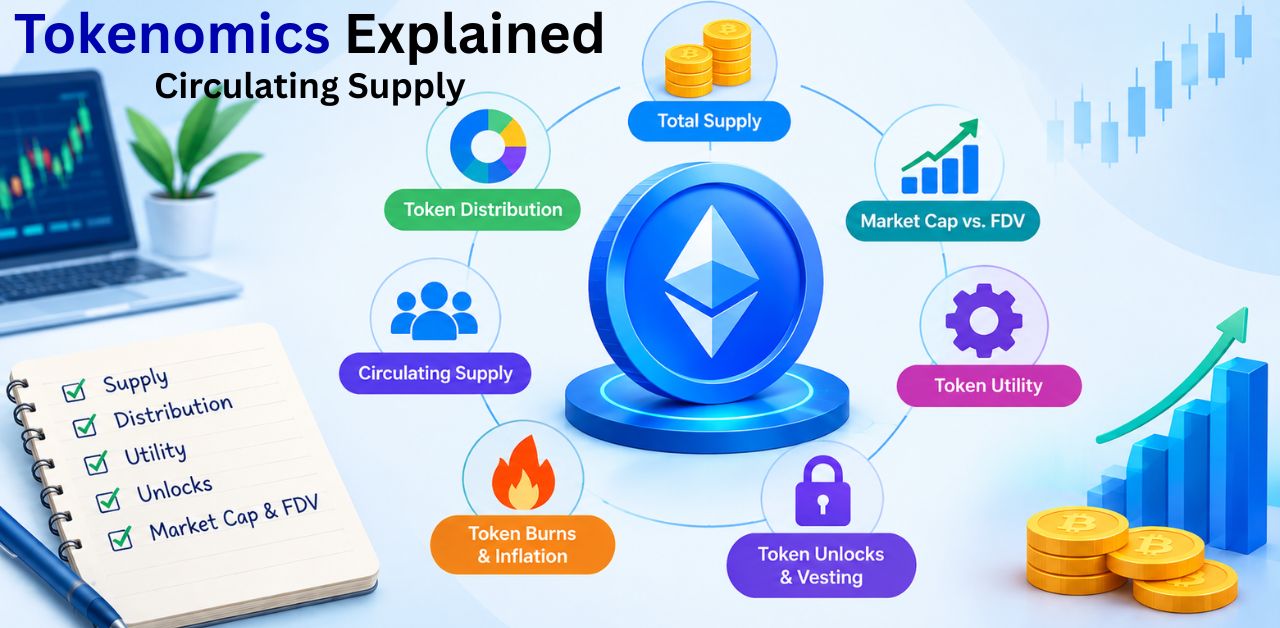
Circulating supply refers to the economic design of a cryptocurrency or digital token. It encompasses key aspects such as supply, distribution, utility, token unlocks, incentives, and burning mechanisms.
If you wish to venture into the world of crypto, this guide will help you understand Token + Economics—the entire economic system of a crypto token. Here, you will learn about total token supply, ownership distribution, how new tokens are introduced, and their specific use cases.
What Is Tokenomics?
When you are interested in a particular token, it is essential to examine all related information to gain a proper understanding of it. You should pay attention to these key aspects of tokenomics:
Take the “Ada token,” for example; examining its tokenomics helps you understand how its price is determined.
- Total Supply: The Total number of tokens.
- Circulating supply: How many tokens are set to enter the market?
- Token Allocation: The percentage of tokens distributed among the team, investors, community, rewards, etc.
- Utility: The purpose of the token—such as fees, staking, governance, etc.
- Burn: Whether the token can be destroyed. Inflation: The schedule for releasing tokens into the market. Token Unlock.
- Supply Mechanics: Circulating supply—the quantity present and available in the market.
- Distribution and Allocation: Determines how tokens are distributed among the team, investors, and the community.
- Vesting and Inflation: Information regarding the issuance of new tokens.
How Circulating Supply Work?
For example, if the total supply is 1 billion tokens, the circulating supply might be 300 million tokens (those currently in the market), while the remaining 700 million tokens could be locked, held in reserve, or otherwise out of circulation.
Circulating supply changes over time. Therefore, to understand the factors that actually influence token prices, you need to monitor both current and future supply.
Element Check-To-Token Price
When you are interested in a specific token, it is essential to examine all related information to gain a proper understanding. You should focus on these key aspects:
The most important points are:
Token Supply: You should pay attention to crucial figures such as circulating supply, maximum supply, and total supply.
Market Cap + FDV: Market cap is calculated by multiplying the token’s current price by its Circulating supply, whereas Fully Diluted Valuation (FDV) represents the potential valuation based on the maximum supply.
Token Allocation: This reveals the percentage of tokens held by the team, founders, private investors, and the community. If a large number of tokens are concentrated in the hands of a few, their selling activity could have a significant impact.
- This indicates who holds the tokens; the main categories include:
- Public Sale: A sale open to everyone.
- Community Allocation: Tokens reserved for the community.
- Foundation and Grants: Tokens held by the foundation or awarded to community contributors.
- Insiders: This includes the core team, investors, and companies assisting with the token launch.
Vesting and Token Unlocks: This covers details regarding the number of tokens and their unlock schedules. Large-scale token unlocks can increase circulating supply and selling pressure, although this does not guarantee a price drop.
Token Utility: Why was it needed, and how will it be used?
Solana Tokenomics: A Case Study
Let’s take a look at SOL’s initial allocation and its launch
- Community 38.89%
- Seed Sale 16.23%
- Founding Sale 12.92%
- Team 12.79%
- Foundation 10.46%
- Validator Sale 5.18%
- Strategic Sale 1.88%
- Coin List Auction 1.64%
These are historical figures regarding the initial distribution; you will need to use the CoinMarket platform to view the current ownership percentages.
Solana (SOL) Supply (approximate): This data is based on the current market cap.
Circulating Supply: 588.0 million SOL
Total Supply: 635.0 million SOL
How to Analyze Tokenomics Before Researching
You don’t need to be an expert for this; you just need to be familiar with a few features.
- Check the supply: First, look at the circulating, total, and maximum supply.
- Understand the allocation: Find out what percentage has been allocated to the team, investors, the community, and the treasury.
- Check the vesting schedule: Keep an eye on the timeline for token issuance.
- Understand the utility: Learn why the token was launched.
Learn about issuance and burning: Find out if issued tokens can be removed from circulation over time.
FAQs
What is Crypto Tokenomics?
Crypto tokenomics provides information on how a cryptocurrency’s tokens are created, distributed, supplied, and used within its ecosystem.
Can Tokens Ever Be Burned (Destroyed)?
Yes, tokens can be burned when there is a significant reduction in their supply.
Conclusion
The economic system (tokenomics) encompasses details such as the total token supply and its distribution—including allocations for the team, investors, the community, and rewards—as well as token percentages and unlocking schedules. It also provides information regarding the introduction of new tokens into the market.